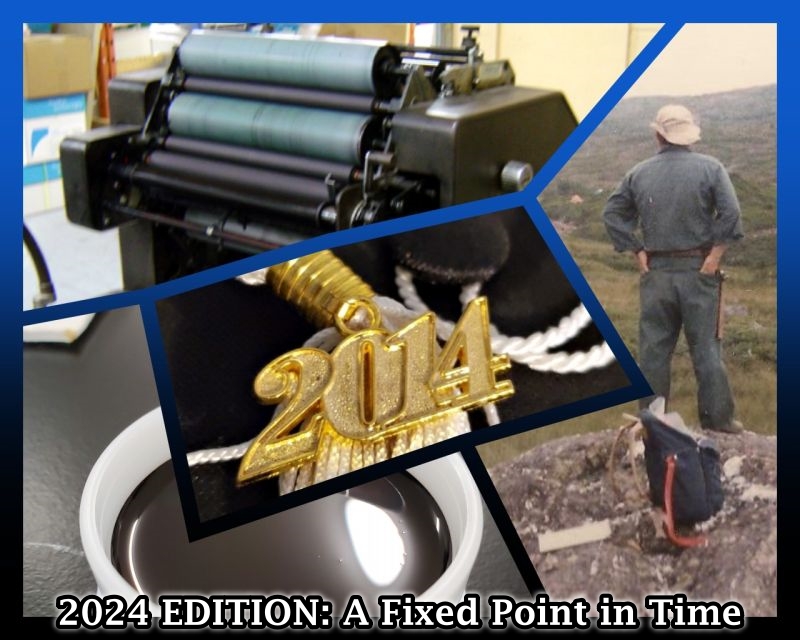
A collection of my columns under The Newfoundland Inkslinger banner that were originally published by the Lloydminster Meridian Booster in 2009-10. This post will be revised frequently as I update and expand it. Please note that due to multiple moves and digital transfers over the years, some articles may have been misplaced. These pieces of writing have been frozen in time, so opinions and personal views may have changed since original writing.
May the strength of three be on your journey
Originally published in the Lloydminster Meridian Booster, Alberta.
January 2009
January 16, 2009 marks three years since I flew down from the Northwest Territories on a
Northern Air Lease plane and arriving in downtown Lloydminster on a Greyhound in a
snowstorm. The passing of time is a flash of memories. Since being introduced to Alberta life by
my cousin, I’ve worked in the city’s best liquor store, sweated in a busy kitchen, moved stock
around in the dusty bowels of a retail empire, made some stupid and wise decisions, and started a
not-yet award winning column series.
What’s in store for 2009, b’ys?
We have yet to see how this plays out, but signs are showing that U.S. President-elect Barack
Obama may be a Danny Williams-like figure down in the States. His recent speech on the
recession was frank and truthful, very much like the one Premier Williams made after he took
office in 2003. Thus far, he meets with my approval. I think after he takes office on January 20,
he’ll be good for the Americans, and the globe in general. In the manner that Williams brought
cautious hope with results to Newfoundland, Obama needs to bring hope and results to the world
hope, especially after the incredible mess the Bush Administration are leaving in their wake.
Canadian politics and our country in general, I hate to say, are also a mess on several fronts. The
Three Stooges Coalition AKA the NDP and Liberals with Bloc support that was signed in
December is in effect, a coup. The concept of democracy has failed, and it seems to me Canada is
now an anarchy. The new Liberal Leader Michael Ignatieff is a worthy opponent to Harper. This
foolishness has at least provided us with some entertainment, but we need strong leadership to
deal with the financial crisis. I didn’t vote for children to run the country. Ultimately, by Harper’s
request, the Governor General prorogued Parliament until January 26. Which again, I didn’t vote
for.
I didn’t make it back home this Christmas, but was stuffed like a harbour tom cod with a few dear
friends, and got lots of loot such as a warm hoodie. God bless your cotton socks.
Have you made any resolutions? I haven’t made any “resolutions” except to better myself in
general. I’m at a point in my life now where I’m mulling over if I want to stick with this business,
or move on and try something new. Every way is likely.
I’m not quite moving on yet, but I close this column with a major announcement: the
Newfoundland Inkslinger has begun to become independent of the Booster and is establishing a
.com Web presence. Point your browsers to www.newfoundland-inkslinger.com (note: inactive) and write to ian-inkslinger@newfoundland-inkslinger.com (note: inactive) if you have any news tips or column
ideas for me to chase.
May the face of every good news and the back of every bad news be toward you. 2009… give ‘er!
A question of constitutional contempt
Originally published by the Lloydminster Meridian Booster, Alberta.
February 2008
Newfoundland and Quebec are facing off over a patch of territory that Quebec insists is theirs.
Under Term 2 of the Terms of Union of Newfoundland with Canada, which forms
part of the Constitution of Canada states: “The Province of Newfoundland and Labrador shall
comprise the same territory as at the date of Union, that is to say, the island of Newfoundland and
the islands adjacent thereto, the Coast of Labrador as defined in the report delivered by the
Judicial Committee of His Majesty’s Privy Council on the first day of March, 1927, and approved
by His Majesty in Privy Council on the twenty-second day of March, 1927, and the islands
adjacent to the said Coast of Labrador.”
The pristine Romaine River is currently under threat from Hydro Quebec’s estimated $6.5
billion development plan. Besides from being environmentally pristine, there’s the small
constitutional problem of the fact that this river is actually Newfoundland-Labrador property.
Quebec wishes to produce hydroelectric power on this river, regardless of the fact that it’s
actually in contempt of the Constitution of Canada. In a shocking show of blatancy, according to
the Government of Quebec website, “Quebec does not recognize the portion of the Quebec /
Newfoundland and Labrador border between Québec and Labrador as set by the Privy Council in
London in 1927.”
Tourist, official maps and Canadian Armed Forces maps depicting the Quebec patrol area now
include that area of Labrador as well.
In the 1960s, Newfoundland, to put it mildly, got screwed by the federal government because
they feared national turmoil. Newfoundland has gotten bad bargains in the past, which is great
fodder for debate.
It all began during construction of the colossal Churchill Falls hydroelectric project in
Labrador during the ’60s. Newfoundland wanted permission from the feds to send electricity
through Quebec to the northern United States and Ontario. Instead, Quebec insisted on buying
the power outright. The federal government apparently could have stepped in and legislated
transmission of power through Quebec, but being spineless, they let Quebec do what they
wanted. Coerced into it, the deal was signed by Newfoundland’s first Premier, the controversial
Joey Smallwood, which fixed the sale of the electricity at 1969 prices, prices that in 2008 are
ridiculously low.
In the end, Quebec is prospering with our water power.
For Newfoundland the cost has been billions of dollars. As poor as the new Canadian province
was, this was a brutal blow that continues to bruise today.
Hydroelectric power drives Quebec’s nationalism, but a lot of that power has come
at Newfoundland’s expense.
Premier Jean Charest hopes to take advantage of the clean-energy agreement signed by President
Obama and Prime Minister Harper during the President’s visit to Canada, and sell power to the
States. There’s a clock ticking. If the Williams government can’t settle this in time, the potential
of the Lower Churchill and Romaine Rivers will be lost. Not only that, we risk losing some of
our territory in an incredible act of aggression.
On moral and legal grounds, what side is right?
Mayday: The Loss of Cougar Flight 491
Originally published in the Lloydminster Meridian Booster, Alberta.
March 2009
The North Atlantic is one of the most dangerous seas on Earth. Waves are tumultuous, and the
air currents above wreak havoc. Mammoth icebergs patrol, sinking unsinkable ships like the
Titanic. Newfoundlanders out there earning a living are among the bravest men and women on
the planet.
I went online after work on March 12 to see my Facebook inundated with status updates from
Newfoundland friends about a helicopter incident. The chopper, essentially a flying
bus, was shuttling offshore oil workers to the rigs.
On the morning of March 12th, 2009 a Cougar S-92A helicopter crashed in the Atlantic ocean
approximately 65 kilometers east of St. John’s. Flight #491 was scheduled to drop off two
contractors on the Hibernia platform and 14 employees on the SeaRose FPSO. The two-man
crew reported mechanical problems with the gearbox and radioed for permission to return to St.
John’s.
Except for one survivor, they didn’t make it. Robert Decker is still recovering in hospital as of
press time.
The helicopter and bodies were recovered by the offshore supply vessel Atlantic Osprey. The
chopper was on the sea floor mostly intact but with significant damage, and the tail boom was
broken off and lying nearby.
The Transportation Safety Board found a broken mounting stud on March 20 on the helicopter.
The U.S. Federal Aviation Administration was prompted to call for the part to be replaced on all
Sikorsky S-92A helicopters worldwide…immediately. Otherwise, they’re grounded.
Sikorsky Aircraft Co. has not responded to my inquiries regarding this by press time, but I did
find out through research that the corporation had been aware of problems with its mounting
studs. On January 28, an alert saying that the titanium mounting studs should be replaced by steel
studs on every helicopter within a year, or within 1,250 flights. If they had been faster, then 17
lives would have been spared.
According to the Canadian Press, there have been 25 occurrence reports filed with Transport
Canada since Jan. 1, 2006, involving the S-92A model. Rig workers are understandably
apprehensive about flying on this model. All of the occurrences happened on board choppers
owned by Cougar Helicopters during journeys to Newfoundland’s offshore oil platforms. Flight
491 was the first Newfoundland offshore fatality.
I commend Cougar’s sensitivity during this difficult time, but the 25 previous incidents concern
me.
This tragedy has been compared to the Ocean Ranger disaster in 1982. The Ocean Ranger was an
early oil rig that toppled over during a stormy night with the loss of 84 lives. Safety
recommendations based on that incident have not been implemented. Why?
As I read the names of the deceased, I note that they’re from every corner of Newfoundland and
from Nova Scotia, B.C. and from Fort Saskatchewan.
Newfoundlanders attended a multi-denominational service at the Roman Catholic Basilica of St.
John the Baptist on March 18. It was a moving ceremony attended by over 1800, and
demonstrated to the nation our unique sense of community.
I personally am not connected to any of the deceased, but perhaps some of you are.
Remember them dear readers.
(Note: There was no column published in April 2009 due to personal and professional events, which is explained in the May 2009 column.)
“…and the earth did quake, and the rocks rent…”
Originally published in the Lloydminster Meridian Booster, Alberta.
May 2009
Hiatus over. My apologies. I broke from column writing last month because I took an
opportunity to move up from the basement suite I was living in for three years to the main floor
of the house. As I edit this sunlight is streaming in, and the breeze is wafting through. After being
underground for so long, it’s amazing that such simple things are so enjoyable.
April was a month of changes. I consider my move to be a positive one for me personally. Seeing
many co-workers being laid off and hearing about my hometown being rocked by an earthquake
is not.
Yes, the east coast of Newfoundland was indeed rocked by a 3.3 earthquake on the Richter Scale
on Tuesday, April 28. There was little damage done, mostly noise (like a rumble of thunder). I
was told that the family cat went berserk the same evening, as animals are more sensitive to
tremors than humans. A local geologist assured me that there is nothing to worry about. “The
Avalon is supposed to be stable, not much to worry about – an isolated incident caused by minor
deep internal slippage,” he said. The quake’s epicentre was somewhere near Whitbourne.
But there were concerns of a tsunami situation similar to the 1929 Burin tidal wave that flattened the peninsula.
Actually, the earthquake is not really bad news – it’s more of a curiosity. The real bad news this
month was the last run of the Meridian Booster’s newspaper press.
Taking the time difference into account, roughly while the Rock was rockin’, I was on the Booster‘s web press. The Newfoundland Inkslinger had the somewhat sad honour of helping print the last Booster on the Lloydminster presses. I’ve never been on that particular press before, and had no experience up to that point. I just caught the stacks of papers as the machine rolled them out. It’s a spectacular thing to experience as the huge machine thrums and the newsprint is sailing
over your head in a continuous sheet.
From here on in, the Booster will be printed on the Edmonton Sun presses. Company changes
dictated it. The recession and the resulting challenge due to the weakened economy is attributed to be the reason.
The past few days have been spent adjusting to working in a large empty space once populated by
over a dozen people. Voices echo. Newspapers and other news media are an uncertain industry as
the Internet and other technologies fulfill humanity’s need for instant gratification.
However, presses of a different sort will still run at the Booster. The b’ys in the Meridian
Printing’s commercial printing department will continue to serve you. If you want high-quality
business cards, letterheads, brochures, posters, envelopes, invoice books, pads, stickers, and
more made for your business, let us know. [link to MP PDF]
If you’re a concerned loyal reader, I want to assure you that the Meridian Booster will continue to
service Lloydminster and the coverage area. Reporters will be out and about, gathering the news.
The pulse of the web press has been silenced by circumstances beyond our control, but the noble
work of the newspaper marches on.
Perseverance!
Newfoundland: the final frontier
Originally published in the Lloydminster Meridian Booster, Alberta.
June 2009
The explorer credited with officially discovering the island of Newfoundland has a fog of
mystery surrounding his life and career.
Giovanni Caboto (AKA John Cabot). It’s unknown exactly when and where he was born. Perhaps
it was circa 1455 in Gaeta, near Naples. He was the son of a merchant.
By 1461 Caboto was living in Venice, where he became a citizen. In about 1482 he married a
Venetian woman, Mattea, and they had three sons: Ludovico, Sebastiano and Sancio.
Like his father, Caboto traded in spices with the ports of the eastern Mediterranean,
and became an expert mariner.
About 1490, Caboto and his family moved to Valencia in Spain. This was the era of Christopher
Columbus. Caboto was maybe bitten by the exploration bug. Much like Captain Picard, he
wanted to see what was out there. Specifically, across the Atlantic Ocean. The Portuguese and
Spanish wanted to find new routes to Asia and its wealth. These routes would evade the
monopoly on the spice trade held by the Italians. Europeans also wanted to spread knowledge of
Christianity, and to contain the spread of Islam.
Portugal and Spain had no interest in Giovanni Caboto. Once Columbus had returned from his
first transatlantic voyage in 1493 the Spanish likewise thought they had found their route to the
east.
As a result, Caboto turned in 1494 or 1495 to England. He planned to reach Asia by
sailing west across the north Atlantic. He thought that this would be shorter than
Columbus’ southerly route.
In England, Caboto received the support he had been refused in Spain and Portugal. First, the
merchants of Bristol agreed to support his scheme. They had sponsored probes into the north
Atlantic from the early 1480s, looking for possible trading opportunities.
These had been unofficial voyages. In contrast, on March 5, 1496, English King Henry VII issued
letters to Caboto and his sons authorizing them to sail to all parts “of the eastern, western and
northern sea” to discover and investigate.
Whatever Caboto did was in the name of the English Crown.
Caboto made his first try in 1496. It was a failure. The following year, Caboto had
better luck.
Cape Bonavista, however, is the location recognized by the governments of Canada and the
United Kingdom as being Cabot’s official landing. But it’s also possible he landed on Cape
Breton, Labrador or Maine.
The landing by the crew of the Matthew took place on June 24, 1497. Over 500 years ago. That’s
how long the New Found Land has officially been in existence. Some historians think that Bristol
mariners might even have reached Newfoundland and Labrador even before Caboto arrived on
the scene. Indeed, the Vikings (my family’s ancestors) had already landed, but they thought they
were in Greenland.
It’s unfortunate John Cabot didn’t keep better logs. He made a third voyage in 1498, but vanished
from the historical record. It’s assumed he was lost at sea – possibly shipwrecked, starved, or
killed by natives. The research and controversy continues.
There are always possibilities…
Originally published in the Lloydminster Meridian Booster, Alberta.
July 2009
(Factoid: This column marked the end of the regular column series, but it would continue to publish irregularly until my departure from Alberta in 2010. I eventually went on to study Environmental Engineering Technology in Corner Brook, Newfoundland and Labrador. The Newfoundland Inkslinger column series went into slumber as I changed careers, but I continued to contribute to various blogs and newsletters, mostly on the West Coast of Newfoundland and Labrador. The Newfoundland Inkslinger column series was ultimately revived in 2018 and continues to be self-published periodically as of 2025.)
Two years ago this month, I began writing a little column for the Booster. The Newfoundland-
themed column series originated as “Navigating the Issues.” I renamed it to its present
incarnation after a year or so. The new name has a double meaning. I deal with ink regularly in
my day job in the Sheetfed press room, and “inkslinger” is a synonym for writer.
I’ll start by adding some thoughts to what was explored in May’s column. Soon after watching the
Booster newspaper press throttle down for the final time several months back, I decided to grab
my potentially dire situation by the horns and do something I meant to do since graduating from
journalism college in 2004:
Hit the books.
Returning to school has always intrigued me, but then opportunities came about and I was
propelled up North for a few months, and later landed in Lloydminster, where my Western
adventure truly began.
Instead of merely reminiscing about my Animal House days, I’ve decided to give myself a second
chance and make it reality.
Yes folks, the Newfoundland Inkslinger is a wild and woolly college student once again. I’m
starting a degree in management with Athabasca University’s School of Business. As I write this,
I just received confirmation of registration with my first course: Intro to Financial
Accounting, and I’ve just gotten myself set up in the online business school. In a time of
recession, it’s good to know how the economic system works. To get into the nuts and bolts of
the recession situation. Ironically, numbers are not my forte, so I could be off to a rough start.
Lloydminster, for as long as I decide to stick around here, will be my “campus”. For those of you
unaware of it, Athabasca University is a dominantly distance education institution headquartered
in Athabasca with campuses in Edmonton and Calgary. I’ve heard positive things about the
university, although doing a degree in management by my lonesome seems unusual. I’ll require
discipline for sure.
This will take roughly three years, doing one or two courses at a time. I’m hoping I can
accomplish it without a new student loan as I just paid back my original loan last summer. By
roughly 2012, completing this should open new doors. As with everything I do, I’m approaching
the new venture with cautious optimism.
I’ll feel things out with my first course, but due to the intense individualized study of this degree
program, I may not be able to give this column the same priority. My mindset will be re-
focusing as I learn new business and money concepts. The university recommends 11-15 hours
per week per course, not including extra time for assignments and exams. The distance-based
education supposedly is ideal for people working full-time or people with little mouths to feed
who may not have time to go to school full-time.
Thanks for reading this series regularly over the past couple of years. I may drop my cent or two
in the paper every so often.
See you out there.